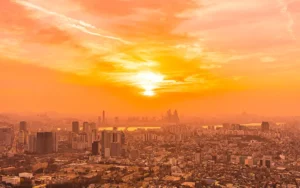

Heat islands: the rise in temperature in urban environments
In a world where cities are in an accelerated growth process and global warming is a palpable reality, the measurement of temperatures in urban environments emerges as a major challenge.
We are faced with the need to capture and understand phenomena such as “heat islands” and fluctuations in relation to historical levels. These phenomena are not only scientific curiosities, but are becoming very relevant in our daily lives.
How heat islands affect the urban environment
Heat islands, urban areas with significantly higher temperatures than their rural surroundings, are a striking example of how human activities can alter the environment.
These are no longer merely abstract concepts in science textbooks, but are clearly manifested in the daily lives of those who live and work in these ever-expanding urban areas. The impermeability of asphalt and the lack of vegetation are just some of the variables contributing to this phenomenon.
One example is what is happening in the city of Paris, which, under these circumstances, is forced to transform itself to lower its temperature and become a more livable city even in heat wave situations.
To address this challenge, Paris plans to plant 170,000 trees by 2026, convert parking spaces into green areas by 2030, and remove 40% of its asphalt.
“The idea is to move from a city that is like a radiator, that has an urban heat island effect, to a city that is an oasis,” said Ecological Transition Councilman Dan Lert.
In this context, the ability to detect, characterize and map sites with high temperatures on a large scale and in comparison to their surroundings becomes a key objective. Imagine being able to identify these hot spots on a map, to understand how they are distributed and how they influence the quality of life of urban residents. This is where technology and science come together.
Assessment of temperatures in urban areas
To achieve this, a multidisciplinary effort is required. Obtaining historical data provides us with a baseline to assess how temperatures have evolved in specific urban areas.
The detection of spatial anomalies allows us to identify hot spots in the middle of the urban mosaic. Comparison with the surrounding environment is essential to understand how local factors influence the formation of these heat islands. It is also imperative to analyze different urban areas and establish correlations with building density, lack of vegetation and other factors that contribute to this thermal phenomenon.
The result of this work lies not only in the accumulation of data and graphs, but in the real impact it can have on our lives. By understanding where and why these high temperatures form, cities can implement effective mitigation strategies.
One could promote tree planting in specific areas, encourage the use of green roofs and more reflective surfaces, or even rethink the layout of buildings and green spaces in urban design.
In short, the challenge of measuring temperatures in urban environments is a call to action. It invites us to look beyond the numbers and delve into the complexity of our ever-changing cities. By addressing this challenge, we are paving the way towards a more sustainable, resilient and livable urban future for all.