“Sponge cities”: urban solution to extreme weather events
Extreme weather events have become a constant. Situations such as the one experienced in Valencia with the passage of the DANA highlight the need to rethink urban planning to protect citizens. The concept of the “sponge city” is a categorical imperative in this context: to ensure the correct permeability of the soil to prevent flooding, while promoting biodiversity.
In the Latin American and Caribbean region alone, nearly 80% of people (some 588 million) live in urban centers, according to data from the State of the Cities in Latin America and the Caribbean report of the United Nations Human Settlements Programme (UN-Habitat). However, the waterproofing of surfaces has been a common practice, the consequences of which we are beginning to face up to.
We should pay attention to countries that are pioneers in the creation of large-scale sponge cities, such as China. Since 2012, it has developed more than 16 projects, including the Jinhua Yanweizhou park in the city of Jinhua. Agforest experts unpack the keys to this novel concept and explain how to apply satellite technologies and artificial intelligence (AI) to address the challenges posed by climate change.
What are sponge cities?
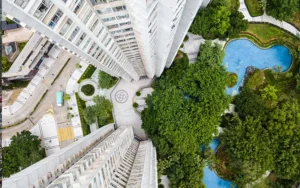
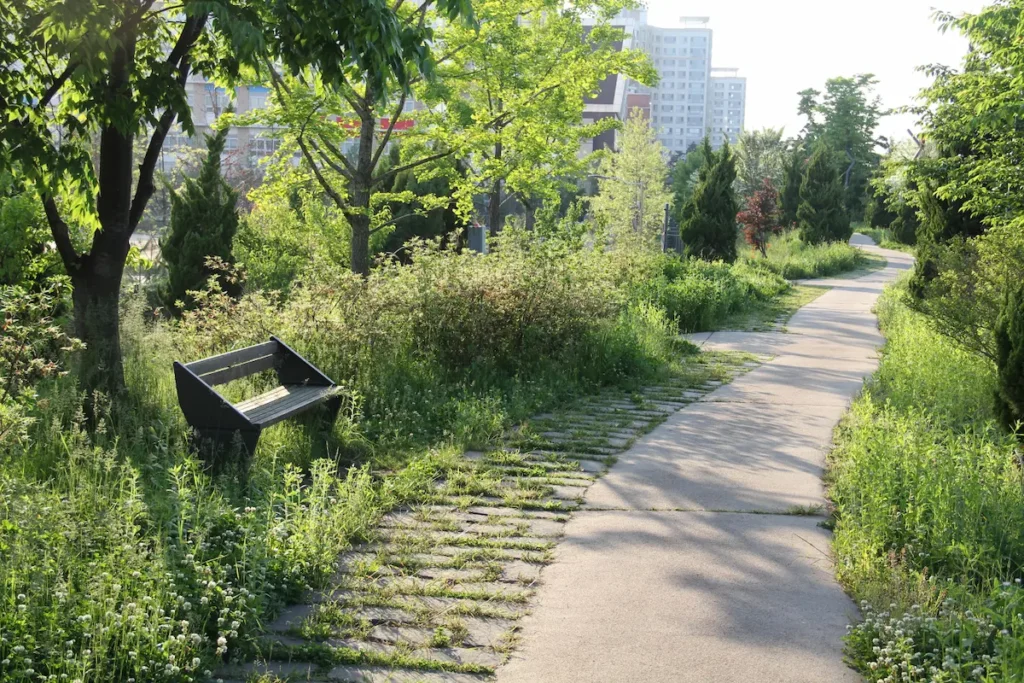
As indicated by the Observatory of Innovation for Sustainable Cities (OICS),the “sponge city” concept refers to water-sensitive urban environments with the capacity to retain, clean and infiltrate water by implementing nature-based solutions (SbN). In other words: making cities a replica of forests in which vegetation is in charge of water management.
Urban planning associated with the growth of cities has been linked to the waterproofing of surfaces. However, this does not prevent runoffs – water currents resulting from excess water not absorbed by the soil – from emerging in the event of torrential rains, among other factors. Thus, increasing biodiversity is the maxim of sponge cities.
Fundamental principles of sponge design
- Soil permeability: Use of porous materials and surfaces.
- Decentralized drainage: Sustainable drainage systems (SUDS) that channel water to natural reservoirs.
- Water reuse: Collection and storage for irrigation, cleaning and urban cooling.
- Ecological integration: Creation of green areas and restoration of river banks to promote biodiversity.
The urban impact of extreme weather events
Climate change is intensifying extreme weather events. According to recent reports, the volume of rainfall in torrential events has increased globally, resulting in more frequent and severe flooding. In contrast, prolonged droughts are affecting water supplies in many regions.
In urban environments, these phenomena have a devastating impact:
- Urban flooding: Impervious surfaces such as asphalt and concrete hinder water infiltration, which generates rapid accumulations of rainwater.
- Loss of biodiversity: Urban ecosystems suffer due to the lack of natural water.
- Economic costs: Flood repairs and emergency measures represent a significant burden for cities.
Sponge cities and urban sustainability
The correlation between sponge city and vegetation means that its benefits transcend water management. This revolutionary urban planning model has great potential to have a positive impact on sustainability from a broad point of view. It is worth highlighting the essential aspects that sponge cities have an impact on in order to measure their scope:
- Flood management: the elements that make up the green cover act as SUDS (Sustainable Urban Drainage Systems), thus preventing runoffs that affect cities as a result of waterproofing and constitute a flood risk.
- Reducing temperatures: Increased vegetation has a direct impact on reducing temperatures in cities. The phenomenon known as urban heat island (UHI) can be mitigated by increasing green cover.
- Health and quality of life: numerous studies have shown that vegetation reduces the incidence of certain pathologies and improves quality of life as a result of factors such as improved air quality.
- Increasing financial assets: biodiversity is one of the global priorities to ensure sustainability. The creation or regeneration of habitats can lead to the revitalization of the economy through the commercialization of assets such as CO2 credits.
Satellite data and AI: master formula to combat torrential rains
Undoubtedly, technology has brought about a paradigm shift in urban planning. Satellite data and artificial intelligence (AI) predictive models have become key tools for implementing solutions based on the concept of sponge cities. Identifying vacant land for the implementation of vegetation; knowing the number of trees needed for temperature reduction or modeling runoff to anticipate its impact on cities are just some of their main applications.
Benefits of satellite data
- Runoff prediction: using climate and water data, AI can simulate extreme rainfall scenarios and predict where water accumulations will occur.
- Data-driven planning: models that optimize the location of green infrastructure and retention areas.
- Flood early warning: systems that integrate meteorological data and historical patterns to issue real-time warnings.